


Contents

Back
What Is Programmatic Advertising? How Does It Work?
Programmatic advertising is the automated buying and selling of digital advertising space through software, connected platforms and transaction rules. A typical transaction takes place while a webpage or app loads. Advertisers use demand-side platforms (DSPs), while publishers use ad servers, supply-side platforms (SSPs), ad exchanges and publisher-side ad management platforms. The four main deal types are open auctions, private marketplaces, preferred deals and programmatic guaranteed. EMARKETER forecasts US programmatic digital display ad spending will exceed US$200 billion in 2026, with most automated buying transacted through direct deals.
What Is Programmatic Advertising?
Programmatic advertising removes much of the back-and-forth involved in matching campaigns with ad space. Advertisers set their budgets and audience rules, then buying platforms look for suitable impressions across websites, mobile apps and other digital channels.
A simple way to understand it is as a rapid digital auction. When an eligible impression becomes available, buying platforms evaluate its context, permitted audience signals and campaign requirements. From there, the platform may bid for the impression or buy it through a direct deal already agreed with the publisher.
This removes much of the back-and-forth around insertion orders, ad trafficking and reconciliation. People still establish commercial terms, campaign goals, brand protections and bidding strategies.
Programmatic does not always mean AI. Machine learning supports forecasting, pricing, creative optimisation and campaign setup. However, software can execute a rules-based transaction without AI. Behavioural data is not always required either. Context, placement, first-party data and other permitted signals may guide the decision.
The Programmatic Ecosystem: DSP vs SSP vs Ad Exchange vs Ad Server vs Ad Management Platform
The programmatic advertising ecosystem has distinct buy-side, sell-side and transaction-layer tools. The table below shows who uses each component and what it does:
| Component | Primary user | Main role | Examples |
|---|---|---|---|
| Demand-side platform (DSP) | Advertisers and agencies | Centralises programmatic media buying across available inventory sources and applies campaign, budget and bidding rules | Display & Video 360, The Trade Desk, Amazon DSP |
| Supply-side platform (SSP) | Publishers | Makes advertising inventory available to buyers and supports pricing, quality controls and yield decisions | Magnite, PubMatic, Index Exchange |
| Ad exchange | Buyers and sellers through connected platforms | Provides a marketplace or transaction layer where eligible supply and demand meet | Google Ad Exchange |
| Ad server | Primarily publishers in this context | Receives ad requests, evaluates eligible campaigns and demand, and decides what serves | Google Ad Manager |
| Ad management platform | Publishers and ad operations teams | Coordinates inventory, demand, testing, reporting, consent and yield workflows | Publift Fuse |
Demand-Side Platforms (DSPs)
A demand-side platform (DSP) represents advertiser demand in the programmatic ecosystem. DSPs give advertisers one place to buy digital ad inventory across connected exchanges. Before bidding, the platform checks whether the audience, placement and price suit the campaign.
Supply-Side Platforms (SSPs)
Publishers use a supply-side platform (SSP) to send available ad inventory to buyers. Connecting more than one SSP or ad exchange brings extra bids into the auction, while the publisher still controls pricing and access.
Ad Exchanges and Ad Networks
An ad exchange provides the transaction infrastructure through which buyers and sellers trade ad inventory using auctions. It differs from an ad network, which generally packages inventory and sells it to advertisers with its own targeting, pricing or service layer.
Ad Management Platforms
An ad management platform brings several publisher monetisation workflows together without replacing every underlying component. Publift Fuse integrates with Google Ad Manager and SSP connections while supporting auction optimisation, testing, reporting, consent and ad-quality controls. Fuse is a publisher-side ad management platform, not a DSP.
Data Management Platforms (DMPs)
Data management platforms (DMPs) organise and activate audience data for digital advertising. They support DSP and publisher workflows, but they are not required for every modern programmatic transaction.
For more definitions, see our programmatic glossary and comparison of the best programmatic platforms.
How Does Programmatic Advertising Work, Step by Step?
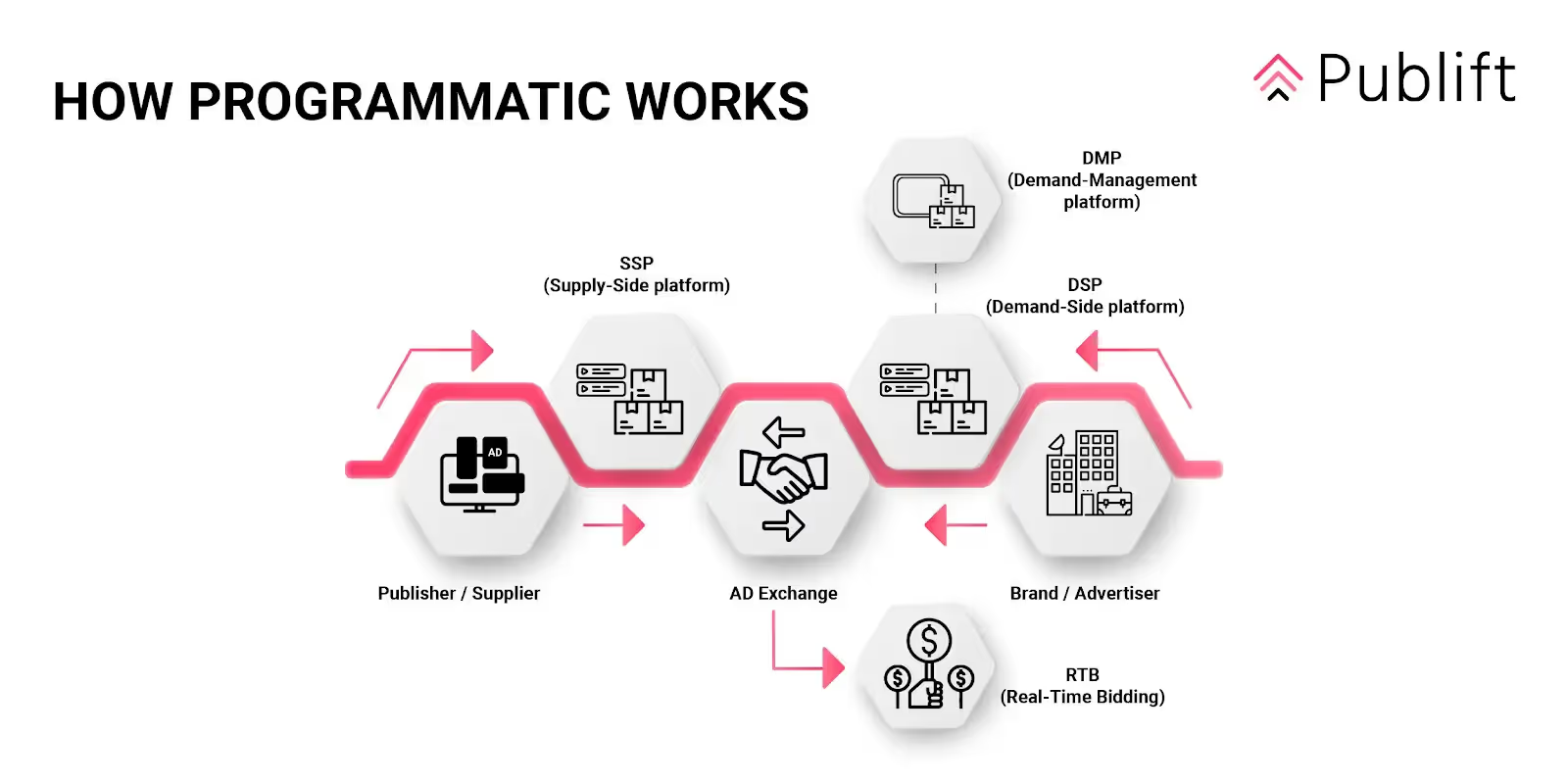
Programmatic advertising works by passing an ad opportunity from a publisher’s page or app to eligible buyers, then returning the selected creative for display. The exact path might vary depending on the setup and demand sources. The entire sequence of the publisher-side flow is as follows:
- A user opens a page or app: The digital property contains an eligible ad placement, creating an opportunity to serve one or more ad impressions.
- The ad server receives a request: The publisher’s ad server identifies the available ad inventory, applicable direct campaigns and connected demand paths.
- The bid request reaches buyers: An SSP or ad exchange makes the opportunity available to eligible buyers. With header bidding, a publisher can invite multiple demand partners to bid before or alongside the ad-server decision.
- DSPs check whether the impression fits: The platform reviews the campaign budget, audience and placement requirements before deciding whether to enter the auction.
- A matching campaign enters the auction: If the requirements line up, the DSP sends a bid. The auction may be skipped when a private or direct deal already applies to that inventory.
- The system selects an eligible ad: It checks the bids against the publisher’s floor price, deal priorities and creative rules. A higher bid is likely to be rejected when it does not meet those conditions.
- The ad renders and events are recorded: The selected creative returns to the page or app. Delivery, viewability, clicks and other available performance data feed reporting, billing and optimisation.
Real-time bidding (RTB) is commonly used to transact individual impressions, but not every programmatic deal involves an auction. Programmatic bidding also includes fixed-price and reserved arrangements. Header bidding increases competition among publisher demand sources, but it is not a separate deal type.
The Four Types of Programmatic Deals
Programmatic deals differ when it comes to inventory access, how prices are set and whether impressions are reserved. These differences affect the scale, control and revenue certainty available to publishers.
[table]
Open Auctions
An open auction makes ad space available to a wide pool of eligible advertisers. This often increases reach and bid competition, although publishers do not know who will win each impression. Floor prices, category blocks and other controls still apply.
Private Marketplaces (PMPs)
A PMP limits the auction to buyers chosen by the publisher. Publishers often use this option for premium inventory, especially when they want more control over access and pricing.
Preferred Deals
A preferred deal lets one advertiser see eligible inventory before it reaches other buyers. The price is agreed in advance, but the publisher does not reserve impressions, and the buyer does not promise a set volume.
Programmatic Guaranteed
Programmatic Guaranteed is a direct deal that reserves a specified quantity of impressions for a buyer at an agreed price. Unlike a preferred deal, it includes a commitment to deliver and purchase the agreed inventory.
Deal Types vs Auction Methods
These deal types should not be confused with first-price auctions, header bidding or Open Bidding. Those terms describe auction mechanics or competition methods rather than the commercial agreement itself. Google’s transaction guide separates programmatic deals by their priority and terms.
In 2026, EMARKETER forecasts that programmatic direct will account for 76.3% of overall US programmatic spend, or 50.4% when social is excluded.
Programmatic Ad Formats
Programmatic advertising can place ads across display, video, CTV, native, audio, digital out-of-home and in-game inventory. The format describes the creative experience; programmatic describes how that ad space is bought or sold.
- Display: Banner and rich-media display ads appear within an article, in a sidebar or inside a mobile app.
- Video and CTV: Video ads may run before streaming content, within a webpage or across connected TV apps. IAB projected total US digital video ad spend at US$72 billion in 2025, although that figure covers digital video overall rather than programmatic video alone.
- Native: Native ads adopt the layout of a feed, recommendation unit or content environment while remaining clearly labelled as advertising.
- Audio: A streaming music service, online radio station or podcast app can insert an audio ad between tracks or episodes.
- Digital out-of-home: Programmatic technology delivers creative to eligible public screens and digital billboards based on location, time or approved data signals.
- In-game: Video games can include display, video, rewarded or intrinsic placements, such as a branded billboard built into the game environment.
These programmatic advertising channels give buyers several ways to reach specific audiences and give publishers more digital advertising space to monetise. Suitability still turns on the content, device, audience and user experience.
Are Google Ads Programmatic?
Yes, parts of Google Ads are programmatic because the platform uses automated auctions and can buy display inventory across Google’s network and eligible publisher sites. It is not normally treated as a full independent DSP equivalent to Display & Video 360.
Google Ads is primarily an advertiser platform for search engine marketing, display, video and other campaign types. When a display campaign is eligible, Google explains that its bid may compete for inventory offered through Google Ad Manager.
Display & Video 360 is Google’s enterprise demand-side platform. It centralises planning, creative, bidding, inventory access and measurement across a wider programmatic buying workflow.
The publisher side is different. Google Ad Manager handles ad serving and inventory management, while AdSense gives eligible publishers a simpler monetisation route. Calling every Google advertising product a DSP hides those separate roles.
Programmatic Advertising in Practice
The following examples show how changes to demand access, ad implementation and yield management affect your ad revenue performance:
OpenGuessr: More Demand Without More Ad Units
OpenGuessr wanted to improve monetisation without interrupting gameplay. We connected the site to 20 SSPs, increased auction competition and adjusted its single-page application setup without adding ad units. From 29 December 2025 to 6 February 2026, OpenGuessr recorded a 46% year-on-year revenue uplift and a 67% increase in RPM.
Trader Interactive: Better Placements and Yield Controls
Trader Interactive already had header bidding, Open Bidding and Amazon demand in place. We worked with its team to improve ad injection and loading, refine layouts and floor prices, and test changes across the stack. Trader Interactive recorded an 88% increase in programmatic page RPM, a 66% year-on-year rise in average daily revenue and a 62% increase in average viewability.
Both of these examples show how demand access, page implementation and ongoing yield optimisation can influence programmatic performance. However, results vary according to each publisher’s audience, inventory and existing setup.
Benefits of Programmatic Advertising for Advertisers and Publishers
Automation is only the mechanism behind programmatic advertising. Its practical value comes from making digital ad buying and selling faster, more scalable and easier to control. These are the key benefits for advertisers and publishers:
Benefits for Advertisers
- A DSP reduces repetitive media buying, trafficking and reporting work across multiple platforms.
- Connected inventory sources provide cross-site, app and channel reach without a separate manual deal for every placement.
- Advertisers can use permitted first-party data, audience data, placement signals and contextual targeting to guide where they place ads.
- Available performance data lets teams adjust budgets, bids, frequency, targeting or creative while an ad campaign is running.
Benefits for Publishers
- Adding SSPs, exchanges and header bidding partners can bring more bids for each impression.
- Price floors and private deals shape who can buy the inventory and at what price. Reporting shows what happens to yield, fill rate and viewability.
- Automating trafficking and reconciliation frees the ad operations team to spend more time on testing and yield work.
- Consent settings cover privacy choices, while category blocks and creative checks deal with unsuitable ads.
Results largely depend on usable inventory as well as the accuracy of data and how it is measured. Advertisers need these inputs to limit wasted spend, while publishers need them to judge whether yield is genuinely improving.
Challenges and Risks of Programmatic Advertising
Programmatic advertising brings automation, but it also introduces certain major challenges such as fraud, transparency, privacy and performance risks.
- Invalid traffic and ad fraud: Bots, spoofed inventory and manipulated events waste ad spend. Ads.txt, sellers.json and accredited verification help buyers and publishers check authorised supply paths.
- Brand safety and suitability: An ad can appear besides unsuitable content, or an unsafe creative can reach a publisher’s site. Category blocks and creative checks help both sides set limits.
- Fee transparency: Each intermediary may take a fee before the remaining spend reaches the publisher. Review the complete supply path, deductions, reporting access and contract terms before adding a partner.
- Privacy and consent: Rules such as GDPR limit how publishers and advertisers collect and use personal data for targeting. Consent settings need to match the user’s location and the data involved.
- Page performance: Every added script or auction timeout can slow the page or cause layout shifts. Check Core Web Vitals and revenue together whenever the stack changes or a new partner is added.
- Weak data or measurement: Poor signals often lead to targeting the wrong audience, repeating the same ad too often or distorting attribution. Contextual targeting, frequency caps and a short list of agreed metrics make these problems easier to spot.
Publishers should compare net revenue with page speed, viewability and ad quality before adding any new demand partners. If revenue increases but the user experience is compromised, improve the existing setup before adding more demand.
Programmatic Advertising in 2026: What Has Changed?
The market continues to grow, while recent programmatic advertising trends point to changes in how inventory is bought, managed and governed.
Programmatic Spending and Revenue Continue to Grow
Forecast spending and recorded revenue both point to market growth, although they measure different things. EMARKETER forecasts US programmatic digital display ad spending will exceed US$200 billion in 2026. The IAB/PwC report found US programmatic advertising revenue reached US$162.4 billion in 2025, up 20.5% year on year.
Direct Deals Take a Larger Share of Spend
More programmatic spend now flows through direct arrangements rather than open-market buying. Programmatic direct will represent 76.3% of total US programmatic spend in 2026, or 50.4% when social is excluded, according to EMARKETER. Video, CTV, commerce media and curated programmatic deals are also attracting more attention.
AI Takes on More Campaign Execution
AI now supports decisions throughout the campaign lifecycle, not only reporting and analysis. Programmatic platforms use it for planning, forecasting, bidding, pricing, pacing, creative variation and measurement. The IAB 2026 Outlook also identifies agentic buying and campaign execution as priorities for US buyers. These tools still require clear goals, controls and transparent reporting.
Chrome Changes Its Cookie and Privacy Sandbox Roadmap
The expected phaseout of third-party cookies in Chrome no longer follows the earlier plan. In April 2025, Google retained Chrome’s existing approach instead of introducing a separate third-party cookie prompt. Google later retired many Privacy Sandbox technologies, including Topics and Protected Audience. Publishers and advertisers still need consent controls, first-party data governance, contextual signals and regional compliance.
Publishers should assess these changes together rather than follow each trend in isolation. New demand paths and AI tools are most useful when they improve net revenue without weakening consent, reporting or page performance.
How Publishers Can Get Started With Programmatic Advertising
Publishers can start with a simple monetisation product, then add more control and demand relationships as traffic, revenue and operational needs grow.
- Start with self-service: A smaller or newer site can use AdSense to access programmatic demand without building a complete ad operations function.
- Add more inventory control: Google Ad Manager helps publishers manage inventory, direct campaigns, delivery rules and reporting from one ad server.
- Increase demand competition: As inventory and revenue grow, publishers can add SSP connections, header bidding, private deals, consent tools and stronger ad-quality controls.
- Consider managed support: A managed partner or enterprise ad management platform may make sense when testing, demand management and yield optimisation require more time or expertise than the internal team can provide.
As a publisher, if you are evaluating the best monetising solutions, check the comparisons of alternatives to Mediavine and Playwire.
Fuse is our publisher-side ad management platform. It brings together demand, auction optimisation, ad layouts, testing, reporting, consent management and ad-quality controls. Publift became a GCPP Premier Partner in July 2026.
If your site earns more than US$2,000 in monthly ad revenue, request a revenue assessment to identify practical opportunities across demand, layout and yield.
Frequently Asked Questions
What Is Programmatic Advertising in Simple Terms?
Programmatic advertising is software-assisted buying and selling of digital ad space. When a user opens a page or app, connected platforms can assess the available impression, apply buyer and publisher rules, select an eligible ad and return it for display, often within milliseconds.
What Are the Four Types of Programmatic Advertising?
The four types are open auctions, private marketplaces, preferred deals and programmatic guaranteed. Open and private auctions use competitive bidding. Preferred deals offer a fixed-price first look without reserved inventory, while programmatic guaranteed reserves an agreed quantity at a fixed price.
Are Google Ads Programmatic?
Yes, parts of Google Ads use automated auctions to buy eligible display inventory, so they are programmatic. Google Ads is not usually classed as a full independent DSP. Display & Video 360 fills that enterprise buying role, while Google Ad Manager serves publishers.
What Is the Difference Between Programmatic and Display Ads?
Programmatic describes the method used to buy and sell advertising inventory. Display describes an ad format, such as a banner or rich-media unit. Display ads can be bought programmatically or through a direct manual agreement, and programmatic buying also covers video, audio, native and CTV.
How Much Does Programmatic Advertising Cost?
Programmatic advertising cost is often expressed as CPM, or cost per 1,000 impressions, although fixed-price, CPC and other arrangements also exist. Actual rates move with the format, audience, geography, inventory quality, deal type, targeting, competition and platform or service fees.
Do Small Publishers Need Programmatic Advertising?
Small publishers do not need a complex programmatic stack to get started. A self-service product may provide basic access to automated demand. Direct SSP relationships, header bidding and managed platforms make more sense when revenue, inventory and operational complexity justify the added work.
Key Takeaways
- Programmatic advertising automates parts of buying and selling digital ad inventory through connected software.
- An ad request enters an auction, DSPs bid, and the winning creative renders.
- DSPs buy for advertisers; SSPs, ad servers and management platforms support publisher monetisation.
- Open auctions, PMPs, preferred deals and programmatic guaranteed use different access and pricing rules.
- Programmatic formats include display, native, video, CTV, audio, DOOH and in-game advertising.
- Advertisers gain scale and targeting, while publishers gain competition, control and stronger yield.
- The main risks are ad fraud, hidden fees, privacy failures, unsafe placements and slower pages.
